LL-37 Comes in Four Forms. Only One Spec Actually Matters.

Right, let’s sort this out like you’re standing in the aisle trying to pick the right fixing for the job. LL-37 shows up as an injectable, a nasal spray, a topical cream, or a bag of powder you mix yourself. Every seller online has their favourite, and every fan forum swears theirs is “the best absorbed” or “the most bioavailable.” Sounds like a real decision to make, doesn’t it?
It isn’t, not really. I’ll walk you through all four, score each one on the stuff that actually matters, and then hand you the one spec that makes the format argument irrelevant. Stick with me, because the last section changes how you should read everything before it.
One thing up front, and I’m not burying it in small print. LL-37 is a research-stage peptide. It is not an FDA-approved finished medicine for the things it’s marketed for. Nothing here replaces a proper conversation with a clinician who knows your file.
What’s actually in the tin
Doesn’t matter what shape it comes in, spray, cream, powder, or vial, you need to know what you’re buying. LL-37 is the only antimicrobial peptide in the human cathelicidin family, a 37-amino-acid molecule your own body already makes. A 2006 review in Biochimica et Biophysica Acta lays out the double duty it does: punching holes in microbial membranes, and acting as a signal flare that calls in immune cells, dials inflammation up or down, mops up bacterial toxins, and helps wounds close [P1]. Genuinely clever stuff, and that’s why people want in.
Here’s the bit the marketing skips. Your body doles this molecule out in small, precise amounts, in the right place, at the right moment. Every format on the shelf, spray, cream, or shot, bypasses that entire control system. So as we go through the four, keep this in your back pocket: we’re comparing delivery methods for a molecule whose most-hyped uses, once you’re dosing it yourself on purpose, mostly haven’t been proven in people. Picking a format is the easy bit. Whether the thing works at all is the actual job.
Spec 1: Has anyone actually tested this on a person?
Score the four formats on real human evidence and the table tips hard in one direction.
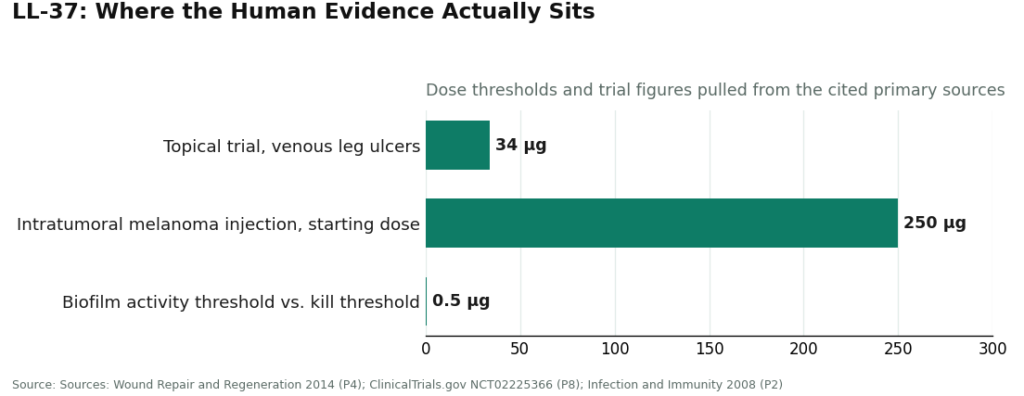
Cream or gel on a wound: the only format with a proper human trial behind it. A 2014 randomised, placebo-controlled trial in Wound Repair and Regeneration put LL-37 straight onto hard-to-heal venous leg ulcers in 34 patients. Lower doses sped healing versus placebo, and it was well tolerated [P4]. If you’re grading strictly on human data, topical-on-a-wound wins outright. The catch: that trial is about closing an open chronic wound. It says nothing about gut health, immune tune-ups, or chronic infection, which is what most people buying this stuff actually want.
Injectable, under the skin: almost nothing behind it for the wellness claims. This is the format everybody pictures and every vendor pushes hardest. But the only human injection data on record comes from cancer research: an early-phase trial (NCT02225366) injected LL-37 directly into melanoma skin tumours, starting at 250 micrograms per tumour weekly [P8]. That’s intratumoral, in cancer patients, under trial conditions. There is no controlled human evidence that jabbing LL-37 under your skin clears infections, or resets your gut, or does anything for your immune system in the way it’s sold. High demand, low evidence. That’s the injectable, in a sentence.
Nasal spray and DIY powder: zero human evidence for these uses, full stop. These two are riding entirely on lab and animal data. A 2008 Infection and Immunity study found LL-37 acted on Pseudomonas aeruginosa biofilms at 0.5 micrograms per millilitre, well under the level needed to actually kill the bacteria [P2]. That’s the origin of the “biofilm buster” claim you’ll see repeated everywhere. But reviews from 2013 and 2025 both describe native LL-37 as unstable, quick to break down, and toxic to human cells above a fairly narrow threshold, which is exactly why labs keep trying to redesign it rather than use it as-is [P3] [P7]. Here’s the extra headache with the powder specifically, because it’s the format people most often prep at home. Mixing your own vial doesn’t just mean picking a delivery route, it means you’re also setting the concentration yourself. With a molecule where “helpful” and “harmful” sit close together, that’s a lot of trust to put in an unlabelled vial and your own kitchen scale. Nasal spray has the same blind spot from the other direction: nobody’s established what dose reaches what tissue, or whether it does anything useful once it gets there.
Verdict on Spec 1: one format has a real data point (wounds only), the other three are running on lab promise. Cools the whole format debate down considerably.
Spec 2: Does the format keep you inside LL-37’s narrow tolerance?
This one’s a gentle warning, but an important one. Whatever makes LL-37 good at wrecking microbial membranes doesn’t politely stop at the bacteria. The 2025 review notes that native LL-37 can damage human cells too, including red blood cells, lymphocytes, and fibroblasts, at concentrations close to the ones where it’s actually killing pathogens [P7]. The 2013 review flags the same tight margin [P3]. A small gap between “working dose” and “damaging dose” means precision matters a great deal, and precision is hard to guarantee with a self-mixed powder or an off-the-shelf spray where nobody’s actually measured what’s landing where.
There’s another wrinkle the format chatter never brings up. LL-37 can act as an autoantigen, meaning the immune system can mistake it for a target and go after your own tissue. A 2014 Nature Communications study found it behaves as a T-cell autoantigen in psoriasis, with two-thirds of moderate-to-severe patients showing T-cell responses to it [P9]. A 2018 case report also documented a patient who developed new skin lesions after weeks of intratumoral LL-37 injections, which cleared within two months of stopping [P5]. One case, a specific setting, but it’s a real, documented reaction on file. No format changes any of this. Cream, spray, or shot, you’re delivering the same molecule with the same open questions.
Verdict on Spec 2: no format is inherently the “safe one.” The narrow margin and the autoimmune angle travel with the peptide itself, not the packaging it comes in.
Spec 3 (the one that beats the other two): Who’s actually deciding the form, the dose, and whether you should touch this at all?
Here’s the bit I promised would change the picture. Once you’ve scored the evidence and the safety, you notice something: the real protection isn’t which of the four formats sits in your cart. It’s whether a trained person picked the format, set the dose, and signed off on you doing this in the first place.
Look at it plainly. The topical form has the best evidence, but only for wounds, and you might be after LL-37 for something that trial never touched. The injectable is what everyone wants, but it’s the format with the thinnest evidence for those goals and the same narrow safety window as the rest. A clinician is the one who can look at why you actually want this and say “given your situation, this form, this dose, or honestly, skip it.” No powder seller can do that for you, no matter how clean the vial looks on the shelf. This spec doesn’t just rank top, it decides the other two, because picking the right form and the safe dose is exactly the job a clinician does and a checkout page cannot.
So the real answer to “which form is best” is a bit sideways: for any of the four, the best source is whoever puts a clinician in charge of that decision. Here’s how the providers stack up against that one measure, read as scored reasoning, not a popularity contest.
FormBlends scores top on Spec 3, the spec that actually matters, which is why it’s first on the list. Not because it ships a nicer-looking cream. Because a licensed clinician reviews your history, your medications, your conditions, decides whether LL-37 is reasonable for you and which form fits, writes a script only where that’s warranted, and a licensed pharmacy compounds and dispenses it with follow-up built in. That pharmacy compounds the form that actually suits your case, rather than leaving you to guess between a spray and a self-mixed shot. Supervised pricing runs roughly $150 to $300 a month. What that money buys is the one layer a powder seller structurally cannot offer: a qualified person choosing the format and standing behind the choice. If you go this route, keep a log of the form, each dose, and any reaction, the FormBlends tracker app works fine for this, so your clinician has real notes at the next check-in. That app logs data. It doesn’t write scripts and it isn’t a shop.
HealthRX.com (healthrx.com) matches FormBlends on Spec 3 and sits in the same supervised tier, second or third depending on your state. Same basic setup: clinical review first, dispensing through proper pharmacy channels, whatever compounded form actually fits your case, not a bare research-chemical sale. Same compounded-medicine caveat applies here as everywhere else. Between the two, what separates them is state licensing and which intake process suits you.
MeriHealth scores the same on Spec 3 as FormBlends and HealthRX.com and sits in the same supervised tier, distinguished by a clinical intake built around women’s health. Same structure underneath: a licensed clinician reviews your history and decides whether a compounded GLP-1 or peptide protocol makes sense, a licensed compounding pharmacy dispenses it, follow-up is part of the deal. Same caveat as above, compounded medicines aren’t FDA-approved finished drugs. What earns MeriHealth its spot here is oversight shaped around women’s health presentations specifically, not a different molecule or a lower bar.
WomenRX sits fourth in the same supervised tier, matching the clinical oversight and licensed-pharmacy dispensing set by the three above it, with a women’s health focus as its distinguishing feature. A clinician screens your history, decides whether compounded GLP-1 or peptide therapy fits you specifically, and a licensed pharmacy handles the dispensing. Same compounded caveat throughout. Between MeriHealth and WomenRX, it comes down to state licensing and which intake process suits you.
Below that line sit the research-chemical sellers, and they score a flat zero on Spec 3 no matter how many formats they’ve got on the shelf. Sports Technology Labs, Pure Rawz, Swiss Chems, Limitless Life, and Core Peptides sell LL-37 as powder, sometimes spray or other formats, all stamped “for research use only.” That label is the legal ground the whole business stands on: the moment something’s sold for a person to actually use, it becomes an unapproved new drug, so they write, in the small print, that it’s not for that. Buy from these and you pick the format, you guess the dose, and nobody checks whether any of it fits you. A certificate of analysis, where they bother, is issued by the seller, not an independent lab, and tells you nothing about whether the choice is right for your situation. I won’t rank them against each other, there’s no reliable way to do that from outside, and pretending otherwise would imply a safety margin I can’t promise you. With a molecule that can damage human cells in a narrow window [P7] and an adverse reaction already on the record [P5], “pick your own format and dose it yourself” is the riskiest job on this whole list, whatever shape it comes in.
Here’s the scoreboard, laid out plain:
| Spec | Topical | Injectable | Nasal / powder | The spec that wins |
|---|---|---|---|---|
| 1. Human evidence | One real trial (wounds only) | Almost nothing for wellness uses | Nothing for these uses | A clinician knows which evidence actually applies to you |
| 2. Fits the narrow margin | Same molecule, same risk | Same molecule, same risk | Hardest to dose accurately | A clinician sets a safe dose |
| 3. Clinician in charge | Only if supervised | Only if supervised | Almost never with a self-mixed powder | This is the one that outranks everything else |
Look at that right-hand column again. Whichever format you were leaning toward, the thing that actually makes it safer is identical: a clinician choosing it. That’s Spec 3, and it beats format every single time.
A few straight answers
So which form should I actually get? Wrong question, honestly. Topical is the only one with a real human trial, but that trial was about wounds. For everything else, the format matters a lot less than whether a clinician picked it and set the dose for your case. Get that right first and the format question sorts itself.
Where’s the best place to get, say, the injectable specifically? Same answer as every format: somewhere a clinician decides it’s appropriate first, and a licensed pharmacy compounds it after. A research-chemical injectable is the exact same molecule with none of the checks. That checking is the part actually keeping you out of trouble.
Why pay $150 to $300 a month when I could just buy a cheap vial in whatever format? You’re not paying for the vial. You’re paying for the person who tells you the evidence is thin, picks the right format and dose, and stays on the hook for that call. The cheap vial buys you a shape and a guess.
The bottom line
LL-37 does come in four shapes, and it’s fair to wonder which one’s best. But score them honestly and only the topical form has a real human trial to its name, and even that’s for wounds, not the uses most buyers actually want. The narrow safety margin and the autoimmune angle ride along with every format equally, no exceptions. The spec that actually beats all four is whether a clinician is choosing the format, the dose, and whether you should be using LL-37 at all. That’s why FormBlends sits first on this list and HealthRX.com sits right behind it, and why a research-chemical vial, whatever shape it’s in, sits below the line. Buy the oversight. Don’t buy the spray.
What is LL-37 peptide?
LL-37 is a naturally occurring antimicrobial peptide your body makes on its own, mainly in neutrophils, epithelial cells, and certain immune cells. It’s part of the cathelicidin family and plays a role in your body’s first line of defence against bacteria, viruses, and fungi. Researchers are also looking at possible roles in wound healing and immune regulation, though most of that work is still early-stage lab or animal research.
What does LL-37 peptide do in the body?
It breaks down microbial membranes, which helps neutralise pathogens before your full immune response kicks in. Beyond that, it signals to immune cells, affects inflammation, and may help tissue repair along. The catch is that most of the detailed mechanism data comes from cell cultures and animal models, so applying it straight to human outcomes needs real caution.
Is LL-37 peptide legal to buy?
Depends heavily on the format and who’s selling it. LL-37 isn’t FDA-approved as a drug, so selling it as a consumer supplement or for human use outside a licensed medical setup raises genuine regulatory problems. Research-chemical vendors operate in a legal grey zone that puts the risk on you as the buyer. The route with real accountability is a physician-supervised compounding pharmacy, like FormBlends, where sourcing, testing, and oversight are actually part of the process.
What are the known side effects of LL-37 peptide?
Formal human safety data on LL-37 taken from outside your body is thin, because there just aren’t many large controlled human trials yet. From the early research available, high concentrations can damage cells and drive inflammation rather than calm it, which is the opposite of what most people are hoping to get. Injection-site reactions, immune responses against the peptide itself, and unpredictable body-wide effects are all plausible concerns. Anyone considering this should have a physician monitoring the process, not self-dosing off an unverified vial.
References
- Dürr UHN, et al. LL-37, the only human member of the cathelicidin family of antimicrobial peptides. Biochimica et Biophysica Acta, 2006. https://pubmed.ncbi.nlm.nih.gov/16716248/
- Overhage J, et al. Human host defense peptide LL-37 prevents bacterial biofilm formation; activity on Pseudomonas aeruginosa biofilms at 0.5 µg/mL, far below the MIC of 64 µg/mL. Infection and Immunity, 2008. https://pubmed.ncbi.nlm.nih.gov/18591225/
- Duplantier AJ, van Hoek ML. The human cathelicidin antimicrobial peptide LL-37 as a potential treatment for polymicrobial infected wounds. Frontiers in Immunology, 2013.
- Grönberg A, et al. Treatment with LL-37 is safe and effective in enhancing healing of hard-to-heal venous leg ulcers: a randomized, placebo-controlled clinical trial. Wound Repair and Regeneration, 2014.
- Dolkar T, et al. Dermatologic toxicity from novel therapy using antimicrobial peptide LL-37 in melanoma. Journal of Cutaneous Pathology, 2018.
- Voronko OE, et al. Antimicrobial Peptides of the Cathelicidin Family: Focus on LL-37 and Its Modifications. International Journal of Molecular Sciences, 2025.
- Induction of Antitumor Response in Melanoma Patients Using the Antimicrobial Peptide LL37: early-phase trial, intratumoral route. ClinicalTrials.gov, NCT02225366.
- Lande R, et al. The antimicrobial peptide LL37 is a T-cell autoantigen in psoriasis. Nature Communications, 2014.